Wednesday, May 15, 2013

Benfica 1-2 Chelsea: Chelsea score at the death


Starting elevens

Chelsea all but emulated the fashion in which they conquered last season's Champions League with a dramatic goal from a right-sided corner kick in the final moments of the match - this time in the 92nd minute, through Branislav Ivanovic.

Jorge Jesus chose to leave the excellent Lima out of the starting line-up (replaced with Rodrigo), while his counterpart Rafa Benítez, without Eden Hazard, was forced to shuffle Ramires to the right flank and deliver midfield patrolling duties to club legend Frank Lampard. Otherwise, the starting elevens were pretty much as expected.

Benfica looked like a transformed team from the one that were beaten by FC Porto last Saturday at Estádio do Dragão. Instead of playing the rare expectant brand of football they put on display in Porto, they reverted to their preferred style and it showed - both in a good and a bad way. Indeed, the Eagles immediately started pressing the minute the referee blew the whistle for the first time.

Chelsea, in turn, seemed oddly overwhelmed and vulnerable down the middle, supposedly one of the areas of the pitch where they tend do excel. Faced with Benfica's high-tempo game and quick accelerations, the Londoners tried to slow the game down, even though Benfica were hardly willing to allow them to do it.


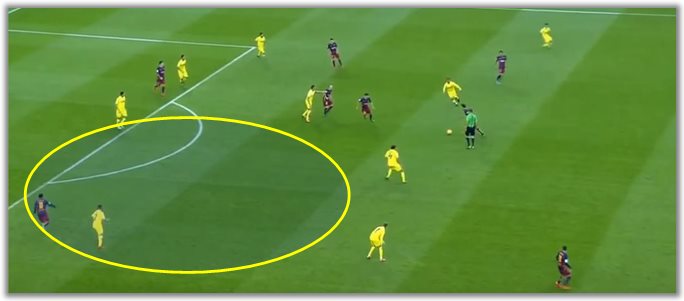
  • Lampard and Luiz too far apart

In the opening stages of the match, Benfica effectively created several excellent chances largely thanks to Nemanja Matic and Enzo Pérez's superb work, only to be let down by their team-mates finishing.


Matic and Pérez dictated most of the action in midfield throughout the first half,
but their influence waned as the match wore on.

Still, the role that both Rodrigo and Óscar Cardozo played cannot be overstated. The young Brazilian forward tended to drop deeper and link up play, vacating the space for Gaitán to exploit and allowing Cardozo to act as a wall against which their midfielders could bounce their passes and thus meet Chelsea defence facing towards goal.

While Cardozo was usually the target for passes in front of the penalty box,
Rodrigo dropped off to his left, often switching positions with Gaitán.

One of the key issues during the first half was the distance David Luiz and Frank Lampard maintained between themselves, often allowing Benfica to bisect Chelsea's midfield and pose numerous threats to their defence. Rodrigo would attract David Luiz's attention, a move that was not duly compensated by Lampard - ergo a space that Benfica swiftly pounced on.

During the first half, Benfica often pushed forward through the centre.
The second half would not bring such good rewards, though.
  • Benfica dominate while Chelsea struggle

Benfica dominated the initial proceedings, with Chelsea struggling to get the ball forward for most of the first period. However, Benítez's men had a clear blueprint laid out for them by their coach, with Benfica's left side the favourite area for Chelsea's attacks. Not only was Ramires, the Blues' main threat in their counter-attacking approach, playing on the right, but Fernando Torres was also instructed to drift to that wing as well.


After the initial 20 minutes, Chelsea started looking more in control, even though there was hardly the impression they were unbeatable through sheer defensive organisation. With Benfica keeping the English from playing out from the back, Chelsea were still finding it quite hard to get past Benfica's back line, even though they always looked dangerous as soon as the ball entered the area behind Matic and Pérez.

Benfica looked more incisive for the opening 20 minutes.

The first half came to an end with the distinct impression that Benfica had been unfortunate not to have scored, something for which they can only blame themselves, after getting into such promising positions. By half-time, despite having attempted more shots, Benfica had hit none on target.


  • Benfica start subsiding

The Portuguese vice-champions started the second half much in the same way they had opened the match - aggressive, direct and with a clear sense of purpose. However, after the first 5 minutes, where they again created some good-looking chances, Chelsea became more positive with their game, often bringing Óscar and Juan Mata into play (albeit still in counter-attacking mode).

Chelsea were less expectant throughout the second half, as the player influence chalkboard clearly shows.
Also, notice the difference in space between David Luiz and Lampard in both halves.

Benfica were managing to work the high defensive line well, but Chelsea's close off-side calls should have provided some warning to their opponents. Instead, the Blues were allowed to score their goal with barely a touch of the ball between Petr Cech and Torres, right down the middle - the area in which Benfica most often look vulnerable. Torres' work must be praised, but the way the goal happened (poor defensive transition on Benfica's part through the centre) can hardly be news for anyone to follows up the team up close.

Even Cardozo was able to level the score though Azpilicueta's unnecessary handball from the penalty spot, by then Benfica were looking less able to stamp their authority on the match (you may want to check Matic and Enzo Pérez's chalkboards a bit farther up once more).

The first-half intricate passing in the attacking third gave way to a more sterile approach in the second period.

Moments before Benfica's goal, Jorge Jesus had replaced Rodrigo - not as lively throughout the second half - with Lima and Ola John for Melgarejo, forcing Gaitán to play at left-back. Chelsea immediately took their attacking down the right up a notch.

Chelsea smelled blood down Benfica's left side with Gaitán at left-back.

Even though the Argentinean worked his boots off, his flank was still Chelsea's favourite target (particularly for Ramires) and it was fitting that the winning goal came from a corner precisely down that side, after another one of Ramires' many sprints.


  • Conclusion

Even though Benfica players, coaches and fans alike will most likely feel gutted over the next couple of days, there is good reason for the club to look ahead with hope. The Eagles looked much more dangerous by remaining true to their style and the fans can hardly complain about the lack of an attacking bite this time around.

Chelsea's maturity and experience at this stage proved all too important, but Portuguese fans must take solace in the fact that their sides do not feel as far removed from English teams as they once did. As for Chelsea, they will probably part ways with a coach that provided them with some stability, a presence in next season's Champions League and yet another European trophy. Not bad for a stop-gap solution.

Saturday, May 11, 2013

FC Porto leapfrog Benfica with one match left

Starting line-ups

The climax for the Portuguese season has finally arrived (or has it? Let's keep in mind that FC Porto have yet to play third-placed Paços de Ferreira away). Last night's match had everything fans from one side or the other from the barricade and the neutral football buffs could want: Intensity, uncertainty about the result, some undercover dirty tricks and a goal in the dying moments. In a match that was under the scrutiny of many people worldwide - since it was the last tittle race still going in Europe's major leagues -, FC Porto and Benfica participated in a hard-fought battle for the Portugal's most important title that must have attracted numerous fans the world over.

While FC Porto coach Vítor Pereira went with his expected side, his counterpart chose not to include Cardozo this time around, favouring Ola John instead and playing Lima as the furthest forward and Nico Gaitán just off him. At the moment this text was written, it was not clear whether the decision was of a strategic sort (to keep FC Porto from overrunning their opponents) or whether it had to do with the Paraguayan's fitness (Benfica are, of course, playing Chelsea next Wednesday for the Europa League trophy and every detail is crucial).


  • FC Porto drive hard


FC Porto came pressing hard right out of the gates, aware that the result was theirs to chase (nothing but a victory would be goo enough). Even though Benfica did not press up high, they had clear instructions to obstruct every passing lane for the Dragons, which worked for most of the match, the odd play notwithstanding. In fact, this was for the most part "um jogo de pares" (literal translation "a game of pairs"), as the Portuguese expression goes. Enzo kept an eye on Moutinho, Gaitán was in charge of tracking Fernando and Matic had Lucho in his area of influence.

With the starting 15 minutes gone, FC Porto were smothering Benfica, but with no clear-cut chance to show for it. The Eagles, in turn, were forced to resort to a more direct brand of football with Lima as the target, often to no avail.

The Dragons found it easy to circumvent Benfica's mild pressing up front by making Fernando drop back in between the centre-backs, bypassing Lima and Gaitán. However, and even though they often found James in favourable positions down the centre, Vítor Pereira's men were not able to provide through-balls, particularly because there was no one willing to run in behind the Benfica defence.

As he often did throughout the season, Lucho González drifted to the wings, for two reasons: Firstly, to clear up space in the middle for James Rodríguez and secondly to allow for overload down the wings. Despite managing to invade Benfica's "block" (to borrow an expression from AVB's book), FC Porto were not making their opponents pay for it.


  • Benfica find their stride


Benfica scored the first goal on 19 minutes following Sálvio's throw-in, an all too similar play to Cardozo's goal against Fenerbahce at Estádio da Luz. Benfica would always look dangerous from that sort of set-pieces, with FC Porto looking unprepared for it. While Jorge Jesus' charges had hardly done anything to deserve the lead, they were comfortable enough (as Jesus' teams always are) to take the most of free-kicks, corners and throw-ins.

Despite conceding a goal five minutes later somewhat fortuitously, Benfica really came into their own after scoring, finally finding their passing groove, with Matic, Enzo and Gaitán the fulcrum around which the team revolved. Gaitán's work rate, in particular, has to be highlighted in face of the usual criticism he often receives for his lack of consistency. His persistence while tracking Fernando was enough to throw a spanner into FC Porto's works and disturb their passing rhythm, while continuing to provide Benfica's out-ball. The first half would end with the home team giving it their all, but Benfica still looking in charge.


  • Second half

FC Porto started the second half in the same fashion they had done in the first period - pressing hard and trying to stifle Benfica's initiative. For the first few minutes, it worked, but, as time went by, Benfica looked more and more sure of themselves, confidence growing as the minutes elapsed.

The Dragons started following their own crowd towards a chippier match, giving way to greater risks and more transitions, something that played right into Benfica's hands and harmed FC Porto's possession-based approach.

James left the centre permanently in the second half, with the right-back Danilo providing the width on the right wing and Varela down the left. There were times where FC Porto's positioning (if not the fluidity) reminded Barcelona's, with Danilo (a la Dani Alves) high up and Alex Sandro further back and tucked in.

As the match wore on, Benfica's assertiveness contrasted well with their opponent's anxiety, with even Otamendi occasionally storming forward in open play - still with no clear-cut chances to show for the dominance.

  • FC Porto dwindle away and harvest the reward

The last 15 minutes were a succession of fouls and time-wasting, with both teams incapable of getting something more out of the match. In that particular respect, Mangala's impetuosity proved once again costly, with several unnecessary fouls at a time when that was hardly necessary.

FC Porto then desperately reverted to a rare 4x4x2, with Liedson alongside Jackson Martínez and Kelvin down the left wing. It would end up being the young Brazilian prodigy who would end up scoring a decisive goal in the dying moments of the match.


  • Conclusion

This match will certainly go down in history as one of the most memorable Clássicos in the Portuguese league. Even though FC Porto were fortunate about the way they found their way to victory, it is likely safe to say that it was a fair reward for a team that gave it their all, well supported by their fans.

As for Benfica, the defeat will cast some shadows over Jorge Jesus and Benfica's accomplishments, namely in this particular match. The last-minute goal will no doubt have Benfica fans complaining about their coach's tendency to design new solutions for big matches, but a distanced analysis will prove that Benfica were quite close from getting what they went to the Dragão for, clearly due to Benfica coach's strategy and planning - as the scanty amount of opportunities for FC Porto testifies.

Wednesday, May 8, 2013

Play's anatomy: 2) Arsenal vs Manchester United

Robin van Persie's return to the Emirates hogged most of the headlines of last April's meeting between Arsenal and Manchester United, where Arsène Wenger's men offered a guard of honor to the new champions.

Even though Manchester United's newfound linchpin ended up scoring a goal, it was Arsenal's goal that showed some of the frailties in Sir Alex Ferguson's team - which leads up to a sub-question: is the midfield pairing of Michael Carrick/Phil Jones enough to bring United the victories they crave, especially in the European stage? Let us then break Arsenal's goal down and see what Manchester United did and didn't do.

  • 1. Van Persie misplaces the pass
In this picture, the ball gets to Van Persie after Manchester United had just won it back. Van Persie almost immediately tries to get the ball to the other side, but the pass goes astray (kids everywhere, this is why your coach is always insisting that you do not try this sort of pass) and eventually arrives at the feet of Arsenal left-back Kieran Gibbs.

  • 2. Gibbs quickly passes the ball to Cazorla
Gibbs delivers the ball to his team's chief orchestrator, Santi Cazorla, so that the Spaniard can initiate the attack. While Van Persie picks himself up, there is no one around Cazorla, Arteta or Ramsay.

  • 3. Poor positioning from Manchester United midfield
Cazorla has all the time in the world to pick his pass. Both Phil Jones (red) and Michael Carrick (orange) have their eyes on the ball - Carrick having Ramsay on his radar -, apparently oblivious to Rosicky. 


  • 4. Poor positioning from Manchester United midfield
Cazorla's simple vertical pass immediately bypasses Manchester United shield comprised of Carrick and Jones. Podolski, somewhat similarly to Higuaín, drifts away from his markers unchecked to get the ball, which means that, in Rosicky and Podolski, Arsenal now have two unmarked players in between the lines.


  • 5. Where's Evra?
Patrice Evra was for the better part of the last decade one of the finest left-backs in the world, if not the best. However, he is no longer able to command the touch line as he once did and - to add insult to injury - his defensive abilities seem to be deserting him as well. In this particular case, notice on one hand how Evra is far away from the action. On the other, notice how Podolski and Rosicky are allowed to wander between Manchester United lines. Not surprisingly, that's the space from where Rosicky will provide his assistance.

  • 6. Evra's man-marking does not work
Assuming Evra was on a man-marking job (hard to envision), he still did a shoddy job of it. He looks distracted by what is happening in the centre of the pitch and not paying enough attention to Walcott. As your abilities start declining with age, game-reading skills become ever more important - one of the reasons why Giggs, Beckham or Zanetti are still able to play the game. In his case, Evra seems to rely excessively on his speed and recovering ability, which has left him wanting in numerous occasions before. Here, he neither closes the space between him and Evans nor does he mark Walcott convincingly.

  • 7. Walcott too quick to catch
With that much space in the centre and facing forward, Rosicky only had to wait for Evans to commit to him and spray the through ball for Walcott to run on to. As stated earlier, Evra is poorly positioned and his stance does not help either, which means Walcott's speed will only be harder to stop.

  • 8. Arsenal score
Afforded acres of space, Walcott capitalised on his speed and managed to beat David de Gea with a well-placed low shot. Despite being the man marking him directly, alienated from the game, Evra is not even the first one to arrive at the "scene."

In case the breakdown was too confusing, take a look at the play and see for yourself.


Play's anatomy: 1) Real Madrid vs Borussia Dortmund

Every once in a while this blog deviates from the analysis of a particular match's trends and incidents, focussing on a specific play or pattern from a specific team. Today we will be dissecting Gonzalo Higuaín and Mezut Özil's typical move during the match that pitted Real Madrid against Borussia Dortmund for the Champions League's semi-finals.

As mentioned earlier, Higuaín is often keen on leading defenders (especially direct markers) astray, clearing up space for his team-mates' penetrations through the middle. In this particular instance, it is Özil who profits from the striker's clever move.

In the first picture, Modric is shufflling the ball from one side to another, looking for the best passing option. Dortmund are apparently well positioned, with bender picking up Özil (orange) and Hummels doing the same on Higuaín (red). When Higuaín sees the Croat midfielder under no pressure, he immediately checks towards the ball, Mats Hummels marking him all the way up. Bender is under the impression that Hummels is free to pick up Özil and leaves him unmarked, with Schmelzer too far wide, ready to press Di María should he get the ball.


What happens next leaves a gaping hole right in the centre of Dortmund's defence. Hummels is dragged out of position by Higuaín, a move that is not duly compensated by either Schmelzer - who remains wide - or Bender - who keeps his position in midfield (most likely because that is not the way Jürgen Klopp instructs his men).


Despite Higuaín's expertly taken first-touch pass to play Özil in, the Turkish wizard is unable to put the ball in the back of the net, wasting a precious chance in the 13th minute.


You can watch the whole play below and see how a three-man move can pick a well-organised defence apart.
video

Thursday, May 2, 2013

Barcelona vs Bayern Munich: The chalkboards


In a week where the once seemingly unassailable Barcelona conceded their first defeat in four years on their own turf and where Real Madrid were a goal shy from getting through to the final, there were some interesting aspects to pay attention to (please find the key to all the images at the bottom of the post). Let's move on to Barcelona vs Bayern Munich.

The world will be (in fact, it already is) talking about the end of a cycle - which may or may not prove accurate, particularly given that Messi is still only 25. There is however another aspect that may not come across as critical, but which may turn out to be as important - to wit, the active role of the wingers in the defensive side of the game.

Both Robben and Ribéry impressed with their work rate, with the French player effectively shutting down Dani Alves, one of Barça's main threats, over the two matches. With the previous day's example of Reus, Götze or Grosskreutz, the old adage according to which an attacker could not be bothered to defend, lest he became too tired to be decisive, could be on its way out.


However, their decisiveness did not seem to affected at all, as the take-on chalkboard demonstrates. Barcelona were oddly at a loss when it came to dribble past opponents (largely because they were facing a very organised team), while Bayern's forwards often found pockets of space to sprint past their markers - chiefly the aforementioned Robben and Ribéry.


Müller proved once again why he dubs himself the "engineer of space", not excelling in any particular aspect of the game, but always surfacing when and where the team need him. At Camp Nou, he was once again all over the pitch, tackling, overloading and helping control.


Despite a more economical approach from the German team, Bayern were still able to create numerous chances, most of them following quick breaks in response to Barcelona's poorly coordinated attempt to press up front. Notice how Bayern's chances in the second leg were the result of longer passes - unlike the previous leg, where their intensity allowed them to buzz around the box.


As for Barça, despite all their efforts, this was not the display of a team of champions. While the number of interceptions may look high, it's actually more important to notice the absence of interceptions in the most important part of the pitch. Barcelona were forced to several last-ditch tackles and interceptions, precisely because the midfield could not provide the proper screening. Bayern's chalkboard implies a more cohesive team, with a clear plan laid out.


Barça's attacking play was not brilliant either, with Bayern forcing them to play square and backward passes and keeping them from playing their favourite diagonal balls through to Pedro or David Villa. Furthermore, giving the ball away cheaply meant that Bayern didn't even need to play a lot of passes in their attacking third to create all those chances.


Therefore, it was hardly surprising to watch Barcelona struggle to muster a shot on target.


The chalkboards of David Villa and Iniesta offer interesting evidence of Barcelona's difficulties. In the striker's case, notice how many backward passes he made throughout the match, apparently unable to get himself in decent positions. As for Iniesta, Javi Martínez's pressure was enough to smother the Spanish wizard's magic, forcing him to short square or backward passes as well, unable to dribble past opponents or find team-mates with through balls.


Real Madrid vs Borussia Dortmund: The chalkboards

In a week where the once seemingly unassailable Barcelona conceded their first defeat in four years on their own turf and where Real Madrid were a goal shy from getting through to the final, there were some interesting aspects to pay attention to (please find the key to all the images at the bottom of the post). We will be starting with first match of the week - Real Madrid vs Borussia Dortmund.

Real Madrid were much more proactive defensively, particularly during the first 20 minutes, when they managed to play higher and push Borussia Dortmund into their own penalty box.


This, in turn, meant that the German team found it harder to get themselves into scoring positions, unlike the first leg, where they were allowed to shoot almost at will.


Offensively, José Mourinho's team also looked quite different. Instead of the first leg's timid counter-attacking moves, Real Madrid managed to penetrate Borussia Dortmund's defence several times, especially during the first 20 minutes. This time around, Real Madrid clearly tried to exploit a perceived weak link in the German side - the left side of their defence.


This attempt to punish Borrusia Dortmund down Real Madrid's right was facilitated by Higuaín and Özil's moves - the Argentinean striker drifted right and took his marker with him, with the German playmaker taking the space vacated by his team-mate. This also freed Ronaldo to come inside and shoot with his right foot.


One of the main differences in this version of Real Madrid was the pint-sized Luka Modric. Here, the Croat showed all his usefulness and proved crucial to help his team when Xabi Alonso was stifled (Jürgen Klopp's main concern, way ahead of Ronaldo, in his own words). Compared to Khedira, it is possible to see how the former Spur's approach is much more hands-on, without losing the necessary defensive bite.


Still (and despite the final score), Real Madrid struggled to make an impact on the match after Borussia Dortmund stopped being tempted by the high-speed transition game. In fact, were it not for the goalkeeper Diego López, the German finalists could have solved the tie much sooner. Real Madrid's gung-ho approach almost backfired spectacularly, but it ended up yielding two goals and a nervous finish to the match.


Thursday, April 11, 2013

Champions League - the chalkboards

Another week, another set of wonderful displays and exciting, close-fought contests in the Champions League. Let's take a look at some of the most significant chalkboards.


  • 1. Borussia Dortmund vs Málaga

While Málaga creating less chances in the first leg, they managed to create them in more dangerous areas.

The pressure exerted by Málaga's forwards kept Gündogan from being as decisive as he had been in the first leg.

Borussia Dortmund's final push meant they managed to get the same number of chances as the first leg.

Oddly enough, Málaga actually made less interceptions than in the first leg,
undoubtedly due to their forwards' impressive work rate.
Notice how the Spaniards made a lot less interceptions in the centre-back area.


  • 2. Barcelona vs Paris Saint-Germain

Barcelona's passing in their attacking third before and after Messi coming on.

Barcelona's chances before and after Messi coming on. Not a huge difference in numbers.

Barcelona's interceptions before and after Messi coming on.
Oddly enough, this was the area where Barcelona improved most dramatically.

Ibrahimovic put in a circumspect yet decisive all-round display against his former employers.

A comparison between the overall contribution provided by Verratti (first leg) and Beckham (second leg).
The Italian midfielder was instrumental for Paris Saint-Germain's solid display.

Chances created throughout both legs. Paris Saint-Germain actually managed to look more dangerous in Camp Nou,
with several chances created down the middle.


  • 3. Bayern Munich vs Juventus
In an unexpectedly one-sided contest, Bayern were far superior to Juventus,
which translated in their almost identical number of shots home and away (albeit more dangerous in the first leg).

Bayern were even more proactive and successful as far as their defensive approach was concerned.
Once again, notice far up many of their interceptions took place, preventing Juventus from threatening their back line.

  • 4. Galatasaray vs Real Madrid
Facing an uphill battle, Galatasaray chose to take the game to Real Madrid, despite their early goal.
In the second leg, Galatasaray defended higher up the field, as it's easily noticeable in the first chalkboard.

Real Madrid's three-goal cushion, in turn, allowed them to work less hard defensively further upfield.